The Burger Product, A Conversation About Organizational Culture
If you’re alive and always on the internet (like I am), then you’ve probably seen the McDonald’s meme. In fact, it seemed like bigger news than the meteor that lit up the sky and shook half the houses in the Lower Mainland. Windows rattled, and there was a boom loud enough to make people stop what they were doing and look outside. Yet this was nothing compared to the burger incident.
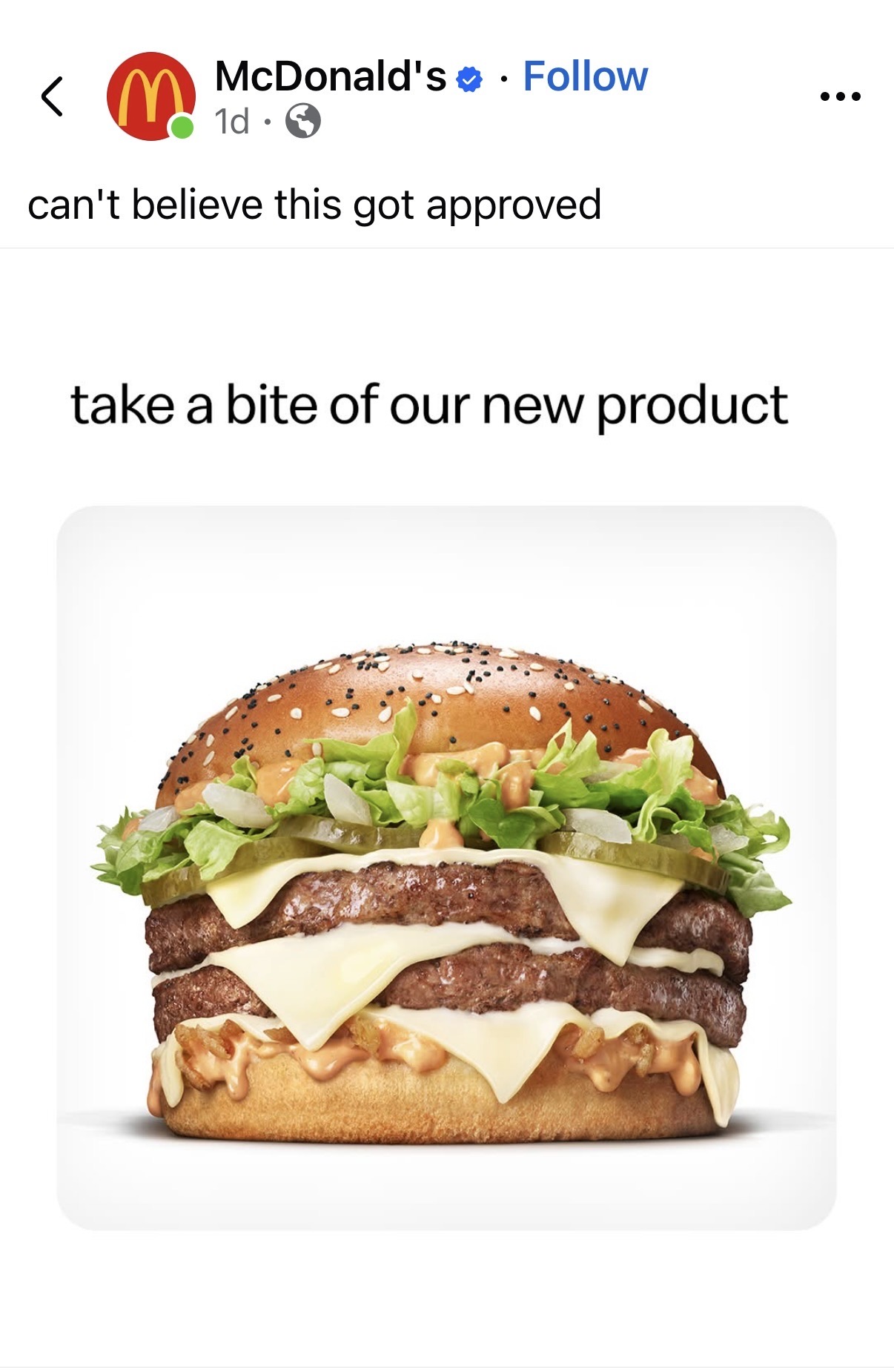
The moment when the CEO of McDonald’s took what might be the world’s smallest bite of a burger, so small that people joked he barely grazed the sesame seeds on the bun.
I’m not going to lie. I laughed for about half an hour.
And honestly, I’m grateful to him for it. It turned what might have been an otherwise mundane day into something funny. For a moment, the internet collectively bonded over the absurdity of watching the CEO of McDonald’s have a burger delivered to his executive office on a silver tray… only to take the most delicate, almost ceremonial nibble imaginable.
It was a man attempting to relate to the common burger eater while barely touching the burger. But the moment actually raises a much larger question about organizations.
How Does Something Like That Get Approved?
This was the meme McDonald’s posted on their social media, and it was funny and in good nature of them to do so. But seriously, McDonald’s isn’t a small company. It’s a massive organization with layers of staff, communications teams, brand managers, public relations advisors, and extensive marketing departments. McDonald’s is essentially an economy unto itself.
It is one of the largest landholding companies in the world, one of the largest toy manufacturers in the world, and it operates one of the most sophisticated marketing machines ever built. So the obvious question becomes:
How does a moment like this make it all the way through the organization?
Think about how many layers something like that would normally pass through:
- Marketing teams
- Brand management
- Communications advisors
- Production teams
- Executive approvals
At no point did someone say, “Maybe this looks a little ridiculous”?
Or did they?
And if they did, why didn’t it stop there? Which leads to a deeper question:
Was it a blunder — or was it a signal about organizational culture?
The Problem of Groupthink
There’s a well-known theory in organizational psychology called groupthink, first identified by Irving Janis.
Groupthink occurs when the desire for harmony or consensus in a group becomes so strong that people stop challenging ideas. Instead of critically evaluating decisions, members suppress dissent to maintain agreement with leadership.
Over time, this creates a culture where people hesitate to disagree with those above them. And when disagreement disappears, so does good decision-making. People may privately think something is a bad idea, but nobody wants to be the one who speaks up. So the idea moves forward anyway.
The Success Trap
There is another dynamic that often appears in successful organizations.
When companies are young, they fight for survival. They get grief everywhere they go, investors doubt them, competitors dismiss them, and employees challenge ideas. It is a time of struggle as the organization is forced to constantly prove itself.
But once a company reaches the top, the pain gives way and suddenly:
- Everyone wants to be associated with success
- People become more agreeable
- Leadership becomes less challenged
And over time, another bias can appear. Psychologists call it the overconfidence bias — the tendency for successful decision-makers to begin believing that their judgment is consistently superior. After enough good decisions, leaders can begin to assume their instincts are always right. This is where a form of magical thinking sometimes creeps in: the belief that because the organization has succeeded before, its decisions will continue to succeed. Even when the evidence suggests otherwise.
When Organizations Become Too Big
Jordan Peterson once said that an organization is never too big to fail. Instead, it is so big it has to fail. When organizations grow past a certain size, something subtle begins to happen. People become cautious about challenging leadership, dissent decreases, and critical thinking slows down. And decisions move forward without the same level of scrutiny that existed when the organization was smaller and fighting to survive.
What the Burger Moment Really Shows
Now, to be clear — I’m not suggesting McDonald’s has lost its ability to think critically. Far from that. In fact, the company handled the internet’s reaction quite well. Their response has been humorous and self-aware, which is often the smartest way to manage a moment like this.
But the interesting part of the story isn’t that the CEO made a slightly ridiculous video. Because honestly, who among us hasn’t done something that looked awkward on camera?
The interesting part is this: in an organization that large, with that many intelligent people involved…
No one felt comfortable enough to stop it.
And that small moment tells us something fascinating about how organizations work, especially when they become very successful. Sometimes the biggest risk to a company isn’t competition. It’s the quiet moment when everyone in the room decides not to disagree.
Now it’s low-key possible that McDonald’s did all of this on purpose, and if they did, it was beautifully brilliant of them. But I guess we’ll never know.